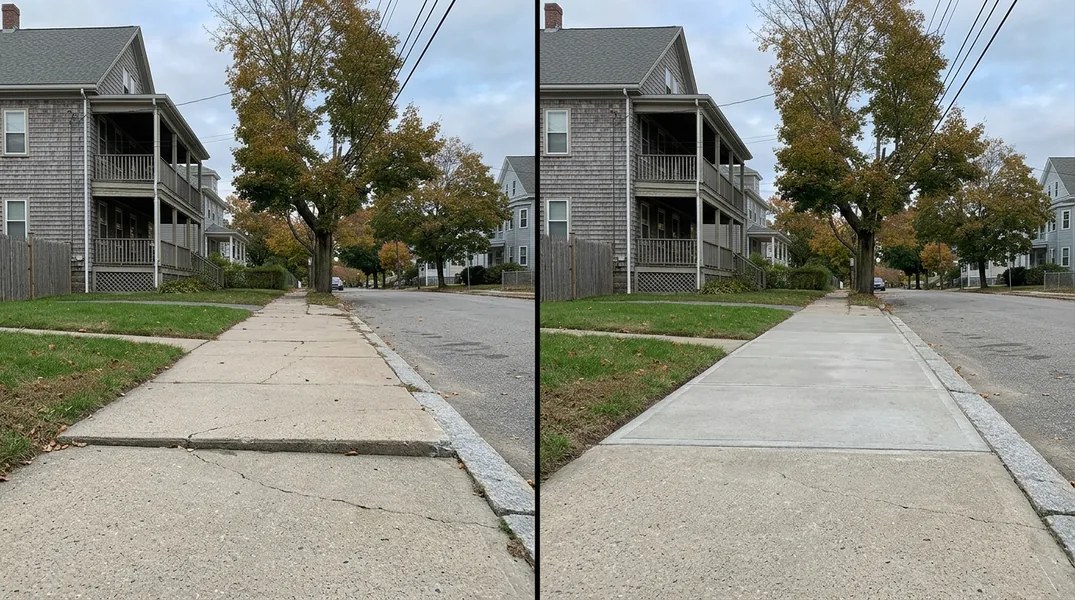
Understanding Providence's Unique Ground Conditions
Providence sits on some of the most challenging terrain in New England. The ground beneath our driveways, patios, and foundations tells a geological story that directly impacts concrete longevity. During the last ice age, glaciers carved through Rhode Island, leaving behind a complex mix of glacial till, bedrock, and ledge that defines the landscape we build on today.
Glacial till is a dense, unsorted mixture of clay, silt, sand, and boulders deposited by retreating glaciers thousands of years ago. This material is found throughout Providence and the surrounding region, creating a foundation that seems solid but behaves unpredictably when exposed to moisture and temperature swings. Unlike uniform, well-draining soils found in other parts of the country, glacial soil in Rhode Island compacts unevenly, retains water in its clay-rich layers, and shifts seasonally. For homeowners with concrete driveways, patios, or foundations, this means the ground itself is working against your investment year after year.
Frost Heave: The Winter Enemy of Concrete in Rhode Island
Frost heave is perhaps the most destructive force affecting concrete in our region. When water trapped in glacial soil freezes during winter, it expands with tremendous force, pushing the ground upward. This upward pressure doesn't lift the soil evenly. Instead, it creates uneven displacement that cracks, tilts, and breaks concrete slabs from underneath. A driveway that looked perfect in October can develop significant damage by March, even if the concrete itself is strong and well-installed.
The problem intensifies because Providence experiences the worst conditions for frost heave: freeze-thaw cycles. We don't simply freeze and stay frozen. Our winters bring repeated thaws, refreezing, and temperature fluctuations that cycle water in and out of the soil repeatedly. Each cycle pushes the concrete up a little more, creates hairline cracks, and widens existing damage. By spring, many homeowners discover that their concrete has settled unevenly, creating trip hazards and allowing water to pool in new low spots. This standing water then freezes again next winter, accelerating deterioration.
Glacial Soil Concrete Cracking: Why It Happens Faster Here
Concrete cracking in glacial soil regions happens for different reasons than in other parts of the country. Standard concrete cracks develop from shrinkage during curing, heavy loads, or poor installation. But in Providence, cracking is amplified by the soil itself. Glacial till's clay content means it absorbs and holds moisture like a sponge. This moisture migrates upward through capillary action, wicking into the concrete from below. Over time, this moisture weakens the bond between concrete and subgrade, creating voids and soft spots that compromise structural integrity.
When freeze-thaw cycles activate, these moisture-laden voids become pressure points. Water expands as it freezes, and the concrete has nowhere to go but up and outward. The result is a network of cracks that radiate from stress points, often in patterns that look like spiderwebs or alligator hide. Unlike cracks from poor installation or design flaws, frost-related cracks in glacial soil regions tend to worsen every winter if left unaddressed. This is why homeowners in Providence often need Concrete Repair & Resurfacing services more frequently than those in regions with better-draining, more stable soils.
Freeze-Thaw Concrete Damage in Rhode Island: A Seasonal Cycle
Freeze-thaw damage is a progressive problem that compounds year after year. The first winter might cause minor surface scaling or small cracks that seem cosmetic. The second winter deepens those cracks and creates new ones. By the third or fourth winter, significant sections of concrete may be spalling (flaking off in chunks), and the structural integrity of the slab is compromised. This isn't a defect in the concrete itself, but rather the inevitable result of placing a rigid material over unstable, moisture-rich soil in a climate with harsh winters.
The damage accelerates when salt is applied for de-icing. Road salt and ice melt products penetrate cracks, accelerate the freeze-thaw process, and chemically attack the concrete. In Providence and nearby areas like Cranston, winter maintenance practices that are necessary for safety ironically speed up the deterioration of concrete surfaces. This creates a difficult situation for homeowners: you need to salt for traction, but salting hastens the need for Concrete Repair & Resurfacing.
Preventing Frost Heave and Concrete Damage: Installation and Maintenance
The best defense against frost heave and freeze-thaw damage is proper installation from the start. When Providence Concrete installs Concrete Driveways or Concrete Patios, we account for local soil conditions by ensuring adequate base preparation, proper drainage, and subgrade compaction. A well-constructed base with gravel or crushed stone, combined with proper slope for water runoff, reduces the amount of water that migrates into the soil beneath the concrete. We also recommend thickened edges and reinforcement in areas most vulnerable to frost heave.
Beyond installation, ongoing maintenance is critical. Sealing concrete every two to three years protects against water penetration and extends the life of your investment significantly. Maintaining proper drainage around driveways and patios, cleaning gutters to prevent water from pooling at the foundation, and addressing small cracks quickly before they expand will help you avoid costly repairs. If you notice any signs of heaving, cracking, or uneven settling, contact Providence Concrete at (401) 246-7317 to schedule a free estimate and discuss repair options before winter arrives.
When to Call a Professional: Concrete Repair Near Me
Recognizing when damage requires professional intervention is essential for Providence homeowners. Minor surface cracks, small chips, and light scaling can sometimes be managed with DIY sealers and fillers. However, if you notice major cracks wider than a quarter-inch, sections of concrete that are heaving or settling unevenly, widespread spalling, or persistent water pooling, professional assessment is necessary. These signs indicate that the problem extends beyond the surface and likely involves subgrade failure or ongoing frost heave pressure.
Providence Concrete specializes in evaluating damage caused by local soil conditions and recommending the most cost-effective solutions. Depending on the extent of damage, options may range from targeted patching and sealing to complete slab replacement. Our team understands how glacial soil, ledge, and seasonal freeze-thaw cycles affect concrete longevity in Providence, and we design solutions accordingly. If you're experiencing concrete damage or want to protect new installation from future problems, reach out to Providence Concrete today at (401) 246-7317 or visit our website to request a free estimate. We serve Providence and surrounding areas, and we're ready to help you build concrete that lasts.
Looking for a professional concrete contractor in Providence? Providence Concrete responds fast for all your concrete needs.
Get a Free QuoteOur services: Concrete Driveways · Concrete Patios · Stamped & Decorative Concrete